If what you're looking for isn't here, type keywords in SEARCH box (right side of this page)

OR look through list of topics in this blog OR look a bit lower for posts in order by date.


Showing posts with label hierarchies. Show all posts

February 16, 2010

Perceptual Centers


My recent post about Centric Systems is a good introduction to this one as it can help prepare one to think "concentrically." Even so, this is not the easiest subject to wrap your mind around, so I'll keep the subject of this post very narrow (and will write more "narrow" posts in the future to get at this bit by bit), and probably simpler than you would like (I write these posts for myself, too, so I try to make things simple and memorable).

When Rudolf Arnheim ("German-born author, art and film theorist and perceptual psychologist" - Wikipedia) wrote about "centers" he was almost always referring to "perceptual" centers. In this post I want to introduce perceptual centers and show how a perceptual center is different than a geometric or a physical center.

THE GEOMETRICAL CENTER

You can only find the geometrical center of something in a figure that is symmetrical, for instance a circle. This is how I do it:

First I put the circle inside a square and then I draw diagonal lines from corner to corner and where the lines cross is the
Geometric center of a circle is where the diagonal lines cross.  Image by Jean Vincent can be used by anyone.
geometric center of the circle. It's right in the middle, as are all geometric centers. (Geometrically, only regular figures have centers.)

You may at first wonder: Aren't all centers in the middle? No, they're not.

THE PHYSICAL CENTER
Take a look at the man holding up the little car, below.

Otto Acron lifting 1500 lbs.  Photo from Wikimedia is in the public domain.
Otto Acron lifting 1500 pounds.

You probably noticed right away that Mr. Acron is not right in the middle between the front and the back of the car; rather, the weight is distributed evenly to the left and right of him, the engine in the front, of course, weighing more than the seats in the back. He has found the physical center of the car.

THE PERCEPTUAL "BALANCING CENTER"

What artists are more concerned with than either the geometric or physical center is the perceptual balancing center (usually just called the balancing center) of a composition. Sometimes the balancing center is in the geometric center, but usually it is not. We locate perceptual centers intuitively, not by weight or measure.

Buddha painting (1173-1176) by Zhang Shengwen. Found in Wikimedia.  This picture is In the public domain.
The Sakyamuni Buddha painted by Zhang Shengwen, China - 1173-1176 - Image from Wikimedia

In the painting above, the balancing center is in fact in the geometric center and that's where you find the Buddha (It is not always necessary that a balancing center has anything at all in it, but here it does). The other people are arranged symmetrically (though not perfectly symmetrically) to his sides and to the front ("below" in the picture). Everyone, including the Buddha at the balancing center, has a circular "halo" behind his or her head. The smaller the figure, the smaller the halo. Although I haven't read who these people are meant to be or what their relationships are to each other and to the Buddha, it seems obvious to me that even if we don't know their names we can infer the place of everyone in the hierarchy by size comparisons, and also distance from not only the central figure but also from those they are closest to, especially those with slightly larger halos who are in some way "superior" to them ....In other words, there are hierarchies within hierarchies (i.e., "centers" within "centers" -- as, for example, a galaxy has "suns" and some of those suns have planets and some of those planets have moons; or as trees have trunks from which sprout branches, from which sprout twigs, from which sprout leaves). The edges of the painting also are considered perceptual "centers" as they also have an effect on perceived relationships within the picture.

Tree branches - New Zealand - Photo from Wikimedia is in the public domain
A hierarchy: trunk, branches, twigs, leaves

Most pictures are not symmetrical, though many are.

Although I've used a symmetrical (though less than perfectly so) painting as an example, most pictures are not symmetrical. That's because they're about life as lived here on earth, not in some mythological "other world" where everything is perfect and never changes. Living in the "real world" implies movement and change, and movement and change are not qualities that are projected by squares or circles or the perfect reflection on one side of a center of what is on the other side. Symmetrical compositions (especially when they are round or square) imply stability and timelessness and so are useful for statements about things that are permanent; obviously the relationships shown in the Buddha painting were not felt by the artist to be in danger of changing. But most paintings are about the struggles and strivings and desires and so on that take place in a society in which everything and everyone does not have a permanent place ... unexpected things happen, planned changes occur, challenges to the present order are constant and often to some degree effective; and of course we - people, animals, plants - grow older, and eventually die (we are always changing), and so most pictures that are about real life are not meant to look like they're frozen in time, but rather like they are "happening." This is why the centers are not usually symmetrically placed.

Most pictures have more than one center.
There are usually several perceptual centers (Arnheim sometimes refers to them as "dynamic" centers) in a picture, which balance around the one balancing center. The balancing center is usually located at or near the actual geometrical center of the picture. Other centers in the picture (not the "balancing" center) are placed in relation to the balancing center and to other centers.

What is a perceptual center?
Arnheim defines a perceptual center as "the center of a field of forces, a focus from which forces issue and toward which forces converge."

What is a dominant (or principal) center?As I understand it, Arnheim uses these terms interchangeably instead of "focal point."

What is a balancing center?
Arnheim says the balancing center is "where all the forces balance one another."

What is this about "forces?" (Also called perceptual forces)
"Visual experience is dynamic....What a person or animal perceives is not only an arrangement of objects, of colors and shapes, of movements and sizes. It is, perhaps first of all, an interplay of directed tensions. These tensions are not something the observer adds, for reasons of his own, to static images. Rather, these tensions are as inherent in any percept as size, shape, location, or color. Because they have magnitude and direction, these tensions can be described as psychological 'forces.'" -- Rudolf Arnheim (Art and Visual Perception, Chapter IX: Dynamics).

I'll attempt to explain more about this subject in upcoming posts. - Jean


A Centric (or Concentric) System
Definitions from The Power of the Center:
BALANCE: The dynamic state in which the forces constituting a visual configuration compensate for one another. The mutual neutralization of directed tensions produces an effect of immobility at the balancing center.
CENTER: Geometrically, the center is defined purely by location as the point equi-distant from all homologous points of a regular figure. Physically, the center is the fulcrum around which an object balances [as in the car being lifted, above]. Perceptually, the balancing center is the point at which all the vectors constituting a visual pattern are in equilibrium. In a broader sense and irrespective of location, any visual object constitutes a dynamic center because it is the seat of forces issuing from it and converging toward it.

RELATED POSTS:
Centric Systems
Round Artworks
The Tondo


NOTES:
1) This post was edited on April 17, 2011, and will be further edited, though that "further editing" will mostly have to do with the term "perceptual center."  Arnheim used different terms that meant the same thing and I hope to make it less confusing.
2) Quotations in this post are from Rudolf Arnheim's books Art and Visual Perception and The Power of the Center.
3) Most of what I have learned (and am continuing to learn) about centers and related subjects is inspired by Rudolf Arnheim's explanations of these things, but it has not been easy to decipher his books though I've read his three most important books (Art and Visual Perception, The Power of the Center, and Visual Thinking) over and over and over again (as well as having read once so far most of the others, all of which I have). In fact two of my Arnheim books especially were literally falling apart until just the other day when I pulled out all the pages that had not already fallen out, then punched holes in them and put them in looseleaf notebooks. They are much easier to read now.


There are some things in the books, of course, which are easily grasped right away (and they are fascinating, which is what causes me to keep at these books -- as well as others of Arnheim's books), and each time I go back and read a book again more of it makes sense to me. But large chunks of his writing were almost impenetrable to me at first. It's because of this that once I feel I really "get" something I try to explain it and illustrate it here so I'll have it written and illustrated for myself (lest I forget any of it!), and hoping it might be of some help to others.
4) The picture of the Buddha painting by Zhang Shengwen and also the picture of the centric system are in the public domain. I made the picture of the circle with the square and the diagonal lines, and of course I took the photo just above; I don't mind if you'd like to use either one of them for anything. - Jean


To subscribe to the Thinking About Art Monthly Newsletter, see toward the bottom of the page.

January 12, 2010

Centric Systems

Shield Pattern

I have no illusions about someone happening upon this post, seeing the title, and thinking "Oh! This sounds like a fun read!"

However, for someone who is just now trying to understand just what centric (or concentric) systems are, it might be a sight for sore eyes (okay, maybe I'm stretching things a little!). At any rate, it's not very long, there are several examples, and it's something artists need to know about.

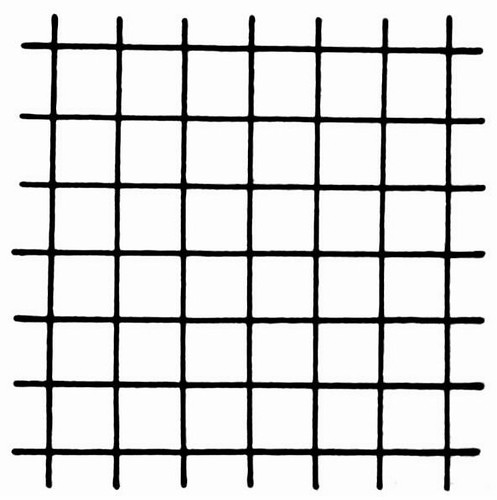
The Introduction to The Power of the Center, by Rudolf Arnheim, begins with this sentence: "This book derives from a single idea, namely that our view of the world is based on the interaction of two spatial systems." Those two spatial systems are the centric system and the Cartesian grid system. They are both gravity-based systems, one (the centric system) natural and one (the Cartesian grid) constructed by humans.


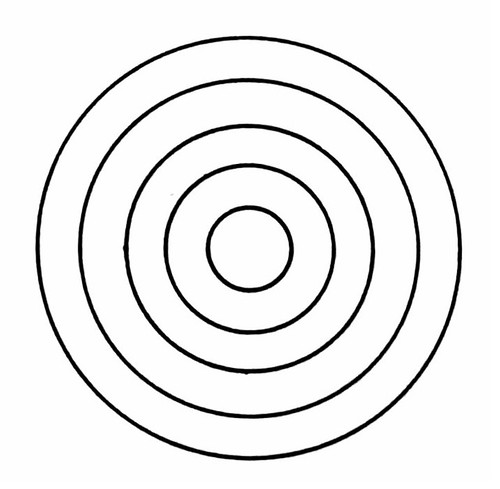
Centric - or Concentric - system
Centric System
Cartesian grid
The Cartesian Grid


Combined centric - or Concentric - and Cartesian grid systems
Combined Centric and Grid Systems

I've written about the Cartesian grid in a post called Art, Gravity, Life, and the Cartesian Grid. Also, in a post on Round Artworks I showed examples of how the two systems are used together in art. The post you're reading now is a (very) basic introduction to centric systems, but it should be kept in mind that the two systems work together (I will write more about that in the future).

DEFINITIONS

In case you wish to refer to them as you read

CARTESIAN GRID: A system of straight lines meeting at right angles, either on a two-dimensional surface or in three-dimensonal space. (The Power of the Center)

CENTRIC: Having a center. (thefreedictionary.com)

CENTRIC SYSTEM: A system organized around a center, either two-dimensionally or three-dimensionally.

CONCENTRIC: Having a common center. (thefreedictionary.com)

COSMIC: immeasurably extended in time and space; vast. (dictionary.com)

GALAXY: A massive, gravitationally bound system that consists of stars and stellar remnants, an interstellar medium of gas and dust, and an important but poorly understood component tentatively dubbed dark matter. (wikipedia.com)

GRAVITY: The fundamental force of attraction that all objects with mass have for each other. (thefreedictionary.com)

HIERARCHY: Any group of objects ranked so that every one but the topmost is subordinate to a specified one above it. (dictionary.net)

PAROCHIAL: very limited or narrow in scope or outlook; provincial (dictionary.com)

SYSTEM: An assemblage or combination of things or parts forming a complex or unitary whole: a mountain system; a railroad system. (dictionary.com)


I include the definitions above because the two systems are called so many different things by Arnheim. Centric systems are also called by Arnheim cosmic systems and concentric systems -- and at least once he refers to a centric system as a cosmic onion. (He also refers to the Cartesian grid as a parochial system.. .not to impress you with his extensive vocabulary, as there is a very good reason for calling it that and also for using the other terms rather than just one for each of the two systems ... but it can be confusing nonetheless to encounter all these names for just two spatial systems, and this is why for the most part I have only used the term "centric" to describe the one system that this post is about.)

TO BEGIN.....

Let's take just the most important definition out of the above table and look at it here. CENTRIC SYSTEM: A system organized around a center, either two-dimensionally or three-dimensionally.

And look at this simple diagram of a centric system again:


Centric - or Concentric - system
Centric (or Concentric) System

Holding that definition and the diagram in mind, read on.

OUR SOLAR SYSTEM - EXAMPLE OF A CENTRIC SYSTEM

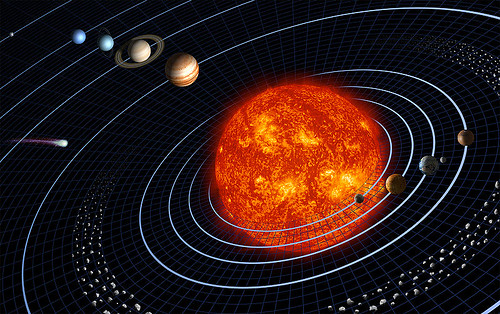
Possibly the best example of a natural centric system, held together by gravity, in this case with the sun at the center, is our solar system (aka planetary system): Earth, Mars, Venus, etc., and the sun [star] they travel around).

Our Solar System - Illustration by NASA

"Our Solar System...showing the Sun, Inner Planets, Asteroid Belt, Outer Planets, the largest object in the Kuiper Belt - Pluto (originally classifed as a planet), and a comet."

A CENTRIC SYSTEM IS USUALLY (IN NATURE) AND OFTEN (WHEN HUMAN MADE) PART OF OTHER CENTRIC SYSTEMS (and sometimes has centric systems within itself)

Just as in our solar system there is the sun (a star) that is orbited by planets some of which are orbited by moons (all of which together make a centric system), in a galaxy there are an incredibly huge amount of stars, some of which are at the center of their own centric systems that include planets (some of which are orbited by moons). In other words, there are what seems to me at least (not being a scientist) probably a huge amount of solar systems (which are centric systems) within galaxies that are centric systems themselves. Centric systems within centric systems, that is. And so on...this not being a science blog nor I a scientist ... but the point is that centric systems often have smaller centric systems within them and, as well, they are often parts of other, larger, centric systems.

GRAVITY IS WHAT HOLDS A CENTRIC SYSTEM TOGETHER

Gravity (roughly defined as the attraction of a smaller mass by a larger mass) is what holds a natural cosmic (centric) system together. You will already know that moons are held in place by the gravitational pull of the planets they orbit, and the planets are held in orbit by the gravitational pull of a star that we call a sun (the center of a solar system), and so on.

A SOLAR SYSTEM IS PART OF A GALAXY, A LARGER CENTRIC SYSTEM

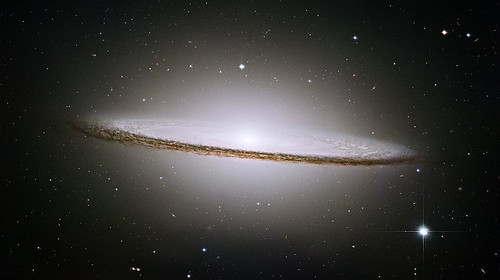
We call the galaxy that contains our own solar system (the solar system is also called a planetary system) the Milky Way. Galaxies do not all have the same shape, but they are all centric systems, even though the "center" of these systems may not be one object but a cluster of many very dense objects (a black hole, stars, dark matter...) all of which add up to an immense gravitational pull on everything further away in the galaxy.


The Sombrero galaxy

The Sombrero Galaxy

The Sombrero galaxy is about the size of our Milky Way galaxy. It probably contains hundreds of billions of stars, many of which are probably orbited by planets. Not only is a galaxy a centric system, but any planetary systems it contains are also centric systems.

EFFECTS OF GRAVITY THAT WE CAN SEE HERE ON EARTH

We and everything around and under us is affected by gravity in many ways. One example of how gravity works is the quite observable (though probably seldom thought of) fact that the pull of gravity of our own planet is holding us to its surface thus preventing us from floating off into space (we feel the pull of gravity on our bodies as weight). The pull of gravity from the center of the earth is the reason it takes energy for us to rise from our beds, to lift our arms (especially when carrying something heavy), to walk uphill or even to walk downhill if the incline is steep as we must expend energy to keep from falling ("falling" means being pulled by gravity). It even causes our nose and ears to grow longer as we age (they sag toward the center of the earth).

Another example, which most of us probably do relate to gravity, as it is fairly common knowledge, is the moon's gravitational pull and (to a slightly lesser extent because it is so far away) the sun's gravitational pull which cause the tides here on our planet. "Tides are the rise and fall of sea levels caused by the combined effects of the rotation of the Earth and the gravitational forces exerted by the Moon and the Sun." (Wikipedia article on tides)

Mont Orgueil at low tide
Mount Orgueil at low tide

CENTRIC SYSTEMS ARE HIERARCHICAL

A centric system is hierarchical and what's at the center is at the "top" of the hierarchy. As you move away from the center, objects are, generally speaking, less affected by the center, and eventually you get to a point where objects belong to another centric system. However, of course, all objects within a centric system are by definition a part of it and affected to some degree by its center no matter how far away they are.

THE SHAPE OF A CENTRIC SYSTEM IS NOT ALWAYS ROUND

"Centric" systems are not always round (natural centric systems are round, or at least symmetrical, only when there is enough space to achieve their ideal shape and when there is no interference by agents -- chemical, physical, or etc. -- that are able to deform them; and certainly centric systems are not usually round in works of art).

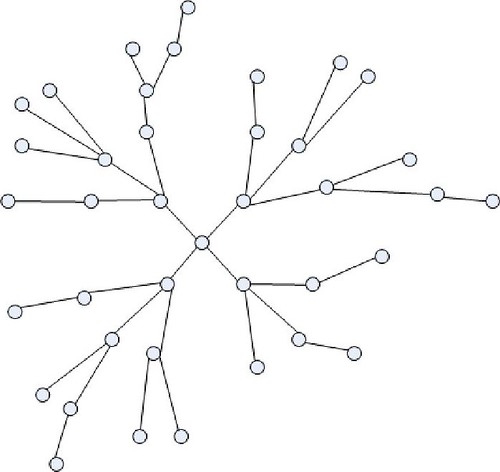
Network Tree Diagram

The "Network Tree Diagram," above, is a good example of a centric system that is not round, nor even symmetrical, yet is a hierarchical system like any centric system. It also shows how a centric system can be a part of other centric systems, as there are actually several centric systems within the large one here.

BIG THINGS, SMALL THINGS -- ALL ARE HELD TOGETHER IN THE SAME WAY

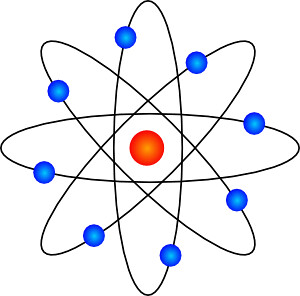
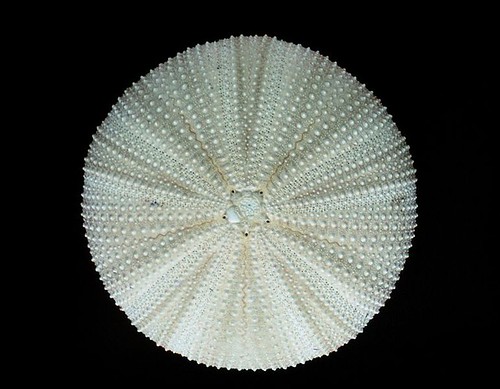
The same thing happens in nature even in systems that are much, much smaller than planetary systems, as all matter attracts other matter, the matter with more mass attracting with greater effect and from a greater distance. However, when it comes to very small objects (compared to planets and moons and stars) gravitational attraction is hardly if at all perceptible. Yet it is there. The pictures below show some examples of smaller centric systems in nature.

Dandelion gone to seedOranges, some sliced in half
Atom modelSea Urchin skeleton

Snowflake
Red daisy with yellow center


"Even in the crowded world of our direct experience, inorganic and organic matter occasionally has enough freedom to follow its inclination and form symmetrical structures -- flowers, snowflakes, floating and flying creatures, mammalian bodies -- shaped around a central point, a central axis, or at least a central plane. The human mind also invents centric shapes, and our bodies perform centric dances unless this basic tendency is modified by particular impulses and attractions." -- Rudolf Arnheim in the Introduction to The Power of the Center.


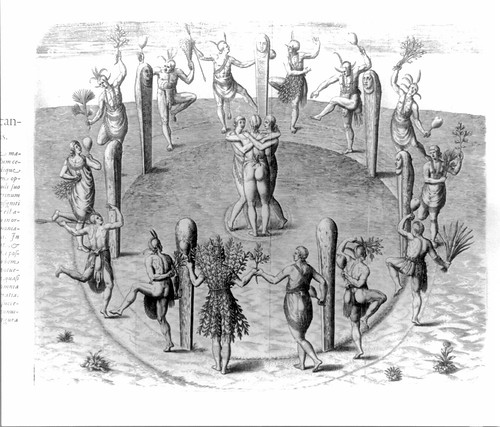
CIRCLE DANCES ALSO CONFORM TO A CENTRIC SYSTEM ARRANGEMENT

American Indians dancing in a circle
American Indian circle dance

"The circle is probably the oldest known dance formation." Wikipedia article on the circle dance

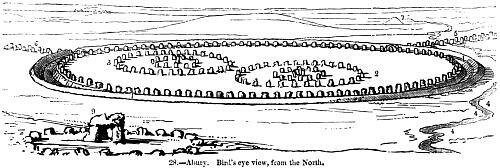
Bird's Eye View of Avebury

Bird's eye view of Avebury, in Wiltshire, England.
(Image from fromoldbooks.org)

Avebury is about 5,000 years old, even older than Stonehenge. You can easily see the centric systems involved in these man-made structures.

WHY DO WE NEED TO KNOW ABOUT CENTRIC SYSTEMS?

Knowledge of how centric systems work in nature (along with knowledge of how the Cartesian grid system that we have imposed upon centric systems in order to organize and understand what we see works) is essential for artists, and often is understood intuitively, if unconsciously. It is likely that we already "know" much of how these spatial systems work just from what we have observed in the world around us and what we have learned from school and books and so on -- and in the case of the centric system, we may even have been born with a tendency to arrange things hierarchically in circles and possibly even to find round or spherical patterns and places comforting (especially when we are at the center) and "complete" (thus satisfying) -- but we may easily mistrust and/or ignore, or even have no conscious awareness at all of this "knowledge" nor any interest in knowing about the spatial systems we live with, not realizing that such knowledge can have any use in art, or how to use it in art. So if we are not already fully aware of how these systems work, and why, it seems like a good idea to learn about these things consciously in order that we can make good use of all this in the art that we produce. And once we have it all in mind, then we need to understand how this knowledge can be useful to us - which I haven't written about here, but will in future posts.

Meantime, if you haven't already, you can read more about the Cartesian grid, and about how gravity influences our perception of the world and even the structures we make to live in, among many other things, in my post called Art, Gravity, Life, and the Cartesian Grid.

_____

NOTE: All pictures used in this post are in the public domain.

To subscribe to the Thinking About Art Monthly Newsletter, see near bottom of the page