If what you're looking for isn't here, type keywords in SEARCH box (right side of this page)

OR look through list of topics in this blog OR look a bit lower for posts in order by date.


Showing posts with label video. Show all posts

April 26, 2011

HENRI EDMOND CROSS

Antibes, afternoon - 1908

Antibes - Afternoon - 1908
Artist: Henri Edmond Cross (1856-1910)

Henri Edmond Cross was a French "Divisionist" painter, though he did not paint in that style until after he had met Georges Seurat and Paul Signac who had invented the technique (they had each come across
this technique separately, then met and developed their ideas further together). Divisionist painters did not "mix" colors, but applied them as small dabs or strokes side by side so that they would "mix" when seen at a distance. This made the colors appear more vibrant.

Cross' original surname was Delacroix but he changed his name to an English version to avoid confusion with Eugene Delacroix. He was born in northern France and settled in Paris in 1881. His early paintings were in the Realist style, but he started painting in lighter colors after he met Claude Monet in 1883; in that year also he spent time in the South of France where he became interested in landscape painting. He met Georges Seurat and Paul Signac in 1884.

Although very interested in the Divisionist (also referred to as "Pointillist" and "Neo-Impressionist") technique, Cross didn't begin painting in the Divisionist style until the year Seurat died, in 1891, beginning with a painting of his wife. In the same year Cross moved to the Mediterranean coast for health reasons.

After 1895 Cross' colors became more intense and he changed from dots to larger brush strokes. He continued to modify his style (but kept to a form of Divisionism) and for a while he painted nudes and mythological figures into his landscapes. In 1897, his friend Paul Signac moved to Saint-Tropez, close to where Cross lived in Saint-Clair. In 1904 Cross met Matisse in Saint-Tropez and they became friends. Cross made two trips to Italy before the end of his life. He died in 1910.

Rocks at Trayas - 1902 - watercolor

Rocks at Trayas - 1902
Artist: Henri Edmond Cross

Note in the following painting by Henri Matisse how he had been influenced by the Divisionist technique of Seurat and his followers, as were many other artists. Divisionism (as well as other post-Impressionist styles, for instance that of Gauguin and of Van Gogh) had a particularly strong influence in the development of Fauvism, of which Matisse was a leader.

Les toits de Collioure - 1905

Les toits de Collioure - 1905
Artist: Henri Matisse (1869-1954)

VIDEO

Henri Edmond Cross
10 MINUTES, 14 SECONDS
(There is no sound with this video.)


To subscribe to the Thinking About Art Newsletter, which goes out on the first day of every month, see near the bottom of the page.

March 18, 2011

Video on The Harvesters by Pieter Bruegel the Elder

THE HARVESTERS - 1565 - by Pieter Bruegel the Elder
(c. 1525-1569)

This painting is also called The Wheat Harvest. It's one of a series of paintings of the months that Bruegel made for a client (Niclaes Jonghelinck) in 1565. One of the paintings is missing, leaving five in different museums. This painting, The Harvesters, was made to represent the months of August and September.

The Metropolitan Museum of Art has an interesting five-and-a-half-minute video in which they talk about this painting. In it they call The Harvesters "the first modern landscape in western art." I would like to have shown the video here, but it is only available at the site, so click here to watch it. Look just below on this post to see the other paintings in this series that have survived.

The Hunters in the Snow - December-January

The Dark Day - February-March

April-May is the missing picture


The Hay Harvest - June-July

August-September is the picture at the top of this post:
The Harvesters, also known as The Wheat Harvest

The Return of the Herd - October-November

The best biography of Pieter Bruegel the Elder that I have been able to find online.

To subscribe to The Thinking About Art Monthly Newsletter, see near bottom of the page.

October 8, 2010

Paul Gauguin - Letters of Discouragement and Hope


Self-portrait - 1889 - (Eugène Henri) Paul Gauguin, Born 1848 in Paris, died 1903 in the Marquesas Islands, French Polynesia
Picture source: The Athenaeum

Have you ever been discouraged by your inability to make the art you want to make because your art doesn't earn you enough money to buy the basic necessities of life much less the art supplies you need, and/or because you are distracted due to difficult living conditions? Then you'll understand what Gauguin was talking about in these letters.

Video - A reading of some of Gauguin's letters
Watch a 14-minute video called Gauguin in his Words at The Guardian, U.K. website in which several of Gauguin's letters to his wife and to friends are read aloud.

Book - At amazon.com
Book: Paul Gauguin: Letters To His Wife And Friends

watering-place-1885

Watering Place - 1885 - Paul Gauguin
Picture source: The Athenaeum

"The future is to the painters of the Tropics, which have not yet been painted. Novelty is essential to stimulate the stupid buying public." (In letter from Paul Gauguin)

Tahitian Landscape-1893, by Paul Gauguin

Tahitian Landscape - 1893 - Paul Gauguin

To subscribe to The Thinking About Art Monthly Newsletter, see near bottom of the page.

September 24, 2010

Edward de Bono on Creative Thinking


Edward de Bono

_____

There are more videos about Creativity in the Thinking About Art Library.

To subscribe to the Thinking About Art Montly Newsletter, see near bottom of the page.

April 26, 2008

Drawing with a Ballpoint Pen - Part 2

Since I wrote a post on drawing with a ballpoint pen recently, I've made up a new video (see below) that shows twenty of my ink drawings. I used a Bic ballpoint pen on all of them, and on several I used other pens also. Before each drawing is shown on the video, it tells what kind of pens I used. They include a Bic ballpoint pen, Sharpie marker, PaperMate felt-tip pen, and Staples gel pen. You can see the video below.

SCROLL DOWN BELOW VIDEO FOR NOTES ON THE DRAWINGS SHOWN IN THE VIDEO

Video Title: 20 Ink Drawings
Time: 6 Minutes, 23 Seconds
Left-click twice (gently) on arrow in middle of picture to begin. There is quiet piano music in the background which makes the video more pleasant, but there is no narrative so you don't have to have your sound turned on. By the way, although the picture you see here is "fuzzy," on the video all the pictures, including this one, are much clearer.


NOTES ON THE DRAWINGS IN THIS VIDEO
All of my drawings are small. I use an ordinary clipboard (the one I used in college for taking notes) as my drawing board. I usually clip on a sheet of ordinary inexpensive drawing paper or else a piece of Bristol board I've cut from the tablet (I prefer the Bristol board for ink drawings, but it's more expensive). Sometimes, not often, I lean a tablet against the clipboard rather than taking off one sheet and clipping it on. The tablet is never bigger than 9" X 12" in size.

When I just clip on a sheet of paper, there are dozens of sheets of 8-1/2" X 11" notebook paper clipped underneath so the backing is firm but also a bit resilient -- just right for drawing. I lean the clipboard against some small boxes that keep it almost but not quite straight up and down (that is, almost at a 90 degree angle). Of course I keep something (heavy and short) in front of it to keep it from sliding forward.

Below is a list of all the drawings shown in the video, in order of their "appearance." I've given the dimensions of each picture (they aren't given in the video, though I do tell what kind of pen(s) I used).

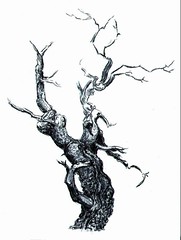
1) Gnarled Old Tree (5-3/4" X 7-3/4")

2) Front of House and Shrubbery (4-1/2" X 8")

3) Back of House and Shrubbery (4-3/4" X 8")

4) Garden Shed Covered with Vines (5-1/8" X 7-5/8")

5) New York City Street Scene (6-1/2" X 5-7/8")

6) Laundry on Hill in China (6" X 7")

7) Narrow Street on Hill in China (5-5/8" X 5-1/8")

8) Mockingbird in the Snow (4-1/2" X 5")

9) Mockingbird Feeding his Baby (3-1/4" X 5-3/8")

10) Cat Eating out of Small Dish (4" X 5-1/4")

11) Grinning Cat Lying on Side (5-1/2" X 6")

12) Sleeping Dog in Wicker Chair (7" X 8")

13) Ground Squirrel (5-3/4" X 7")

14) Rabbit Eating off Ground (6" X 8")

15) Tree Frog (4-5/8" X 6-7/8")

16) 1947 Pontiac Convertible in Junkyard (5-1/2" X 8-1/2")

17) Old Cadillac Convertible in Junkyard (5-1/2" X 8")

18) DeSoto AirFlow with Large Birds in Attendance (5-1/2" X 8-1/2")

19) Wrecked 1957 Oldsmobile in Junkyard (7" X 8")

20) Old car in Junkyard (5" X 7-1/2")
Here is the earlier post on drawing with a ballpoint pen, and here is a newer post on drawing with a ballpoint pen.
_____
Free Newsletter - See bottom of this page.

November 27, 2007

The Aging Face of Rembrandt

By way of his many self-portraits, you can see Rembrandt's face aging - the color fading, the muscles collapsing, skin sagging and getting puffy, and his expression changing from eagerness, happiness, and even playful silliness to tiredness and resignation (and, toward the end, sometimes also a look of amusement as if he were thinking "Life didn't turn out at all like I thought it would, but you see I'm having the last laugh").

Seeing him age through these self-portraits must be especially intriguing to people who themselves are getting old, but surely Rembrandt's portraits appeal to people of all ages, no matter that the subjects may not be "beautiful" or "handsome," and it doesn't only have to do with the beautiful job of painting he did -- The very ordinariness of the people he depicted is part of their appeal (to many, not to all).

One realizes that Rembrandt painted and drew his own aging face without vanity and even with relish (though never without compassion, which he apparently felt for everyone he painted including himself), for all to see. Certainly he was interested in beauty - What artist isn't? But "beauty" means something different to different people. To Rembrandt it was the finest presentation possible of the truth.

People who know their pictures are being painted or drawn probably all hope to be depicted in such a way that they conform to society's view of how a person of their circumstances (age, sex, occupation, family role, etc. - or whichever of these things they most identify with) "should" look and I'm assuming that none of them wish to appear actually ugly. Rembrandt had to consider these things when he painted other people's portraits, but still he made them look like "real people," not slicked-up and stylized people (men all looking pretty much the same...and quite handsome, women ditto...and always beautiful). In so doing, he gave them something that a fake presentation can't muster: dignity, whether they liked it or not. He didn't leave out "imperfections" that made each person unique, though he didn't make caricatures out of them, either, nor was his point to make them ugly.

He also was able to bring out something of their character.

It seems to me that what he did was to make his subjects look like authentic, unidealized people who had the courage and dignity to accept the way they were. We are sympathetic toward them because we see them as honest people.

As for his self portraits, he could paint himself any way he wanted. He could have lied about himself, but instead he found his own odd features, and aging face, fascinating.

Apropos these thoughts, below is a relevant quote from a (very fat, very fact-filled and interesting) book I read recently by Simon Schama, called Rembrandt's Eyes:

From page 699:

"[F]or Rembrandt, imperfections are the norm of humanity. Which is why he will always speak across the centuries to those for whom art might be something other than the quest for ideal forms; to the unnumbered legions of damaged humanity who recognize, instinctively and with gratitude, Rembrandt's vision of our fallen race, with all its flaws and infirmities squarely on view, as a proper subject for picturing, and, more important, as worthy of love, of saving grace."

Below is a video that does a good "morphing" job on several of Rembrandt's self-portraits, from when he was quite young until he was an old man. It makes use of both etchings and paintings. Rembrandt starts out quite young in this video, and gets old before your eyes in just a minute or two, so that when he is an old man you still have in mind his youthful looks - This makes the effect of aging particularly poignant. Although you don't get a good look at each individual picture, you get a startling overall effect which makes you realize one reason why his paintings of people are so powerful (they are "real" people that we can identify with).


REMBRANDT'S SELF-PORTRAITS
LEFT-CLICK ON THE ARROW TO BEGIN
Time: 2 minutes, 23 seconds

After viewing the video, you may want to look at this page, titled:
Rembrandt and his Self Portraits
which has many very nice reproductions of Rembrandt self-portraits. You can see the pictures clearly and take as long as you want to look at them. When you get to the page, click on a small version of the picture, or else the title of the picture, to see it in larger size. It may take a few seconds for the picture to appear then, but it does show up. There's also an article about his self-portraits, toward the bottom of the page.

_____

Free Newsletter - See bottom of this page.